
According to the comic, apparently the development started after Google Gears developers complained about the lack of multithreading facility in current browser.
Some statements that hit me from the comics were:
Wouldn't it be great then to start from scratch and design something based on the needs of today's web applications and today's user?
We want others to adopt ideas from us, just as we've adopted good ideas from others.Sounds like a pretty sincere development to me.
Following are a few key features:
- WebKit is rendering engine used. Its the engine behind Safari (from Apple), Konqueror etc. I have been hearing lot of good things about it, primarily, itbeing the best out there!
- Multithreaded
- New open source JavaScript engine
- Anonymous browsing mode and integrated Google Gears.
- Webapps launching in their own window (much like Mozilla Prism)
- Speed dial and Address bar auto completion ala Opera and Firefox 3 respectively
Got this from WebMonkey.
Having heard quite a bit about ReactOS, I decided take it out for a spin. Vee Dee Eyes became helpful once again by providing a vdi of the latest ReactOS release, 0.3.5.
ReactOS is a very distinct project. Nearly all open source operating systems are basically Unix clones. Be it Linux, OpenSolaris, or FreeBSD. ReactOS goes in a totally different direction by hoping to achieve parity with the Windows platform. The obvious benefit is that it could utilise the gazillions of applications written for the Windows platform. A lot of information on the project is there is the wikipedia article for ReactOS. Very interesting read.
After using ReactOS, I have to say it does feel genuinely Windows like, in both good and bad aspects.
The bad aspect- I encountered a blue screen error within minutes of usage. This has to expected. Not because it emulates Windows, but due to the fact that it is still in very early alpha stage. The good aspect - It feels just like Windows! There are some notable enhancements though. You can add software with a program manager (unimaginatively called Download!) like Synaptic or Yast as in Linux. There are multiple desks as in Linux, which is a real productivity booster. Firefox 1.5 is installed by default, with Firefox 2.0 available to install through Download!
Normal use is nearly impossible since it felt quite flimsy to use. The graphics was getting a bit garbled and there was quite a few issues with screen refresh. As a an early alpha version, this is pretty impressive. The memory footprint is really low and the total download was just around 40 MB as a rar file (uncompressed size - 160 MB).
Is there a chance of ReactOS gaining mass adoption? There are a lot of windows applications in the wild, and a lot of old PCs lying around. Also, if there is a need to run some legacy application, we can always virtualise with ReactOS. Market and the need is out there, with some solid development time put in there is every chance that ReactOS will be a genuine contender in the already crowded OS space.
Hello, Windows 98! Long time no see!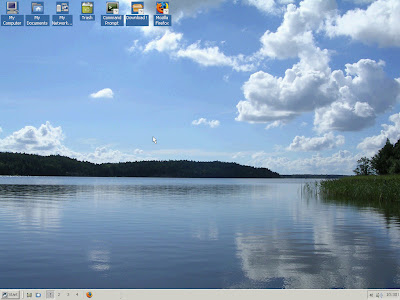
Start Menu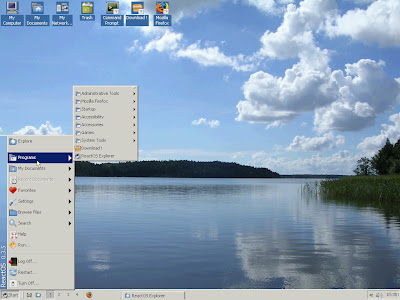
DOS Prompt!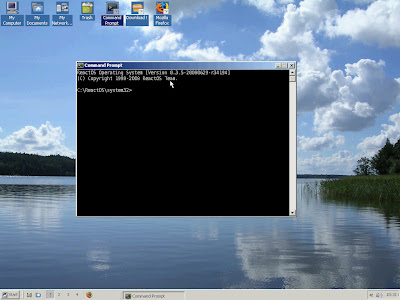
ReactOS Explorer: An enhanced Windows Explorer clone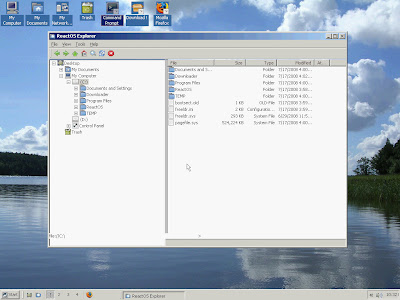
Download! You can install programs using this interface. Very similar to Ubuntu's package manager. You can change the software source is required. There are a few useful applications available like utorrent, Firefox, Abiword etc.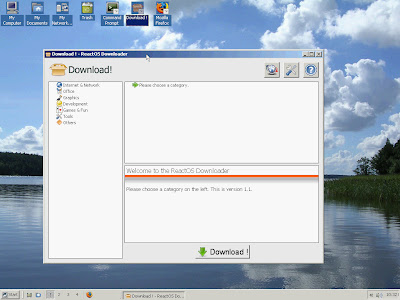
Firefox in action. Notice the weird colour on the browser buttons.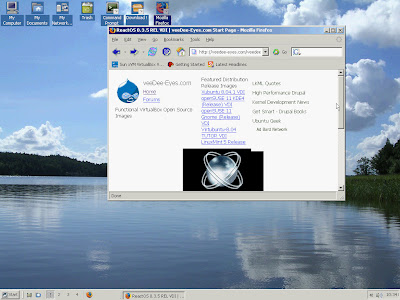
And the Blue Screen of Death!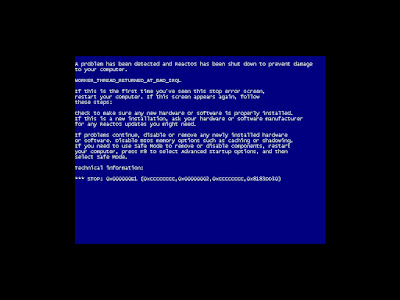
Belenix is an open source operating system based on OpenSolaris. I have been lurking around the Belenix mailing list for a couple of months and it is heartening to see some serious development taking place. The primary attraction was that its a FOSS project from India with a steady development. Secondly, I am curious about OpenSolaris and wanted to see it in action.
Belenix 7.1 was released on July 19. I downloaded an iso only to see it ruined with some checksum errors. Blame it on the acute power shortage leading to constant disruption. Torrent was too slow. Then I chanced upon Vee Dee Eyes. The weird name is the sweetening of vdi, the virtual machine format used by Virtual Box. I was intending to run Belenix from a VM, so I proceeded to download it. Download finished yesterday and I sneaked in a couple of minutes with the system. Really nice to see a fully functional OS and I really liked the KDE implementation. I haven't used KDE for a long time, except for test driving KDE 4.0 from my Ubuntu, which was fairly disappointing. Belenix also includes the latest version of Firefox.
As I mentioned, I only gave it for a very small spin, but the first impression was pretty good. Will give it a grinding and post my experiences. However, a question keeps haunting me. Will this gain traction in an already overcrowded space of open source operating systems? What is the utility of having such a system? I hope to find some answers as we move along!

